A study of 16 experienced open-source developers found that AI tools made them 19% slower — yet they believed they were 20% faster. That single finding tells you everything about the future of software development jobs in 2026. The industry is drowning in hype while the ground shifts beneath it. Coding as a standalone skill is losing value. System design, architecture thinking, and the ability to orchestrate AI agents are now what separate thriving developers from those struggling to find work.
This article covers exactly what is happening with developer employment, why the shift from coding to system thinking is accelerating, and what you — particularly if you are a junior developer or CS student in India — need to do right now.
The Numbers Don't Lie — How AI Is Reshaping Software Development Jobs
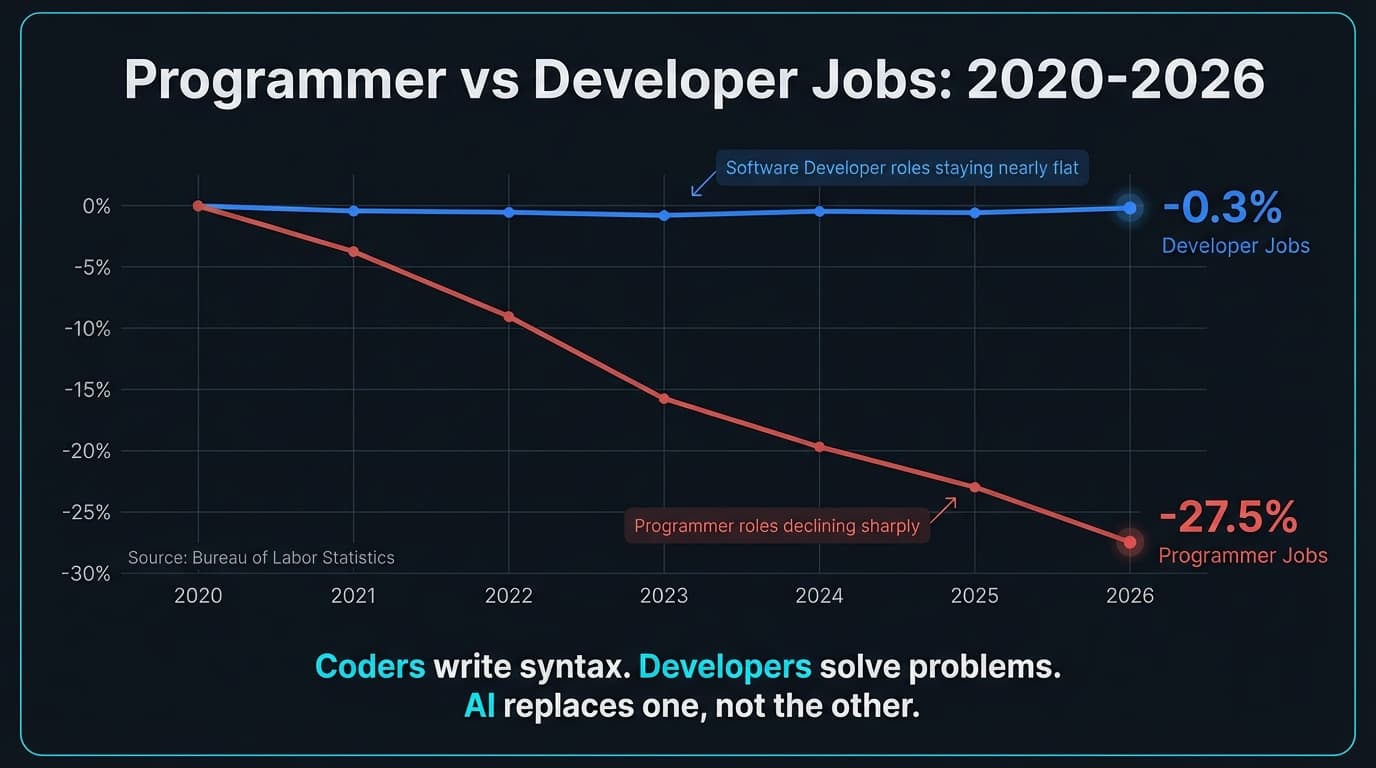
The clearest signal comes from the Bureau of Labor Statistics. "Programmer" job titles in the US declined 27.5% between 2023 and 2025. Meanwhile, "software developer" roles dropped just 0.3%.
That gap is not a coincidence. Programmers write code. Developers solve problems. AI can now do the former faster than any human.
According to a Harvard study of 285,000 firms and 62 million workers, junior employment drops 9-10% within six quarters of GenAI adoption. Senior roles barely change. Similarly, Stanford's Digital Economy research shows that employment among young developers aged 22-25 fell nearly 20% from their late 2022 peak.
Here are the numbers that matter most:
| Metric | Value | Source |
|---|---|---|
| Organizations reducing junior headcount | 73% in past 2 years | CodeConductor |
| Big tech entry-level hiring decline | Down 50%+ in 3 years | FinalRoundAI |
| Recent grads as share of new hires | 7% (was 9.3% in 2023) | Index.dev |
| Tech internship postings | Down 30% since 2023 | Handshake |
| Engineering leaders planning fewer juniors | 54% | LeadDev Survey 2025 |
However, the story does not end with decline. BLS still projects 17% growth in software developer jobs through 2033, adding 327,900 new roles. AI/ML hiring grew 88% year-over-year in 2025 according to Ravio, and AI specialist job postings surged 117%. AI developers now command a 28% salary premium over traditional tech roles.
The jobs are not disappearing. They are transforming.
 Future of software development jobs chart showing programmer roles declining 27.5 percent while developer roles remain stable
From Vibe Coding to Agentic Engineering — A 12-Month Revolution
Perhaps the most dramatic shift in the future of software development jobs happened in exactly 12 months. In February 2025, Andrej Karpathy coined a term. By February 2026, he declared it dead. That speed tells you how fast the ground is moving.
What Is Vibe Coding?
On February 2, 2025, Karpathy posted on X: "You fully give in to the vibes, embrace exponentials, and forget that the code even exists." He called it vibe coding.
Within months, the term entered mainstream vocabulary. Collins English Dictionary named it their Word of the Year 2025. Y Combinator CEO Garry Tan told CNBC that "25% of current YC startups have 95% of code written by AI." Solo developers shipped complete SaaS products — Next.js 15 with Clerk, Stripe, and Supabase — in 11 hours flat.
Development timelines compressed by 45%. Prototypes that took weeks now took hours. We documented a similar acceleration in our own work — see our guide on building AI-powered SaaS in 2026. For a while, it felt like coding itself had been solved.
The Shift to Agentic Engineering (February 2026)
Then, exactly one year after coining "vibe coding," Karpathy declared it "passé." He introduced a replacement: agentic engineering — "You are not writing the code directly 99% of the time. You are orchestrating agents who do, and acting as oversight."
The shift is already measurable. According to GitHub data, 42% of code was AI-generated in 2025. Projections suggest 55% in 2026 and 65% by 2027. Claude Code alone now accounts for 4% of all GitHub public commits, with projections of 20%+ by the end of 2026. Google reports 25% of its code is AI-assisted. Microsoft says 30%.
But here is the crucial finding. The METR study ran a randomized controlled trial with 16 experienced open-source developers working on their own repositories — projects averaging 22,000+ stars and over one million lines of code. AI tools made them 19% slower. Yet those same developers estimated they were 20% faster.
Less than 44% of AI-generated code was accepted without modification.
Speed is not the value AI brings. Direction and judgment are.
 Comparison of what AI coding tools can and cannot do for software development in 2026
What AI Coding Tools Can and Can't Do — The Honest Picture
The AI coding tools market reached $7.37 billion in 2025 and is projected to hit $24-37 billion by 2030. Here is what is actually available:
| Tool | Key Stats | Market Position |
|---|---|---|
| GitHub Copilot | 20M users, 90% of Fortune 100, 42% market share | Dominant incumbent |
| Cursor | $1B ARR in 24 months, $29.3B valuation, 1M+ paying | Fastest-growing B2B SaaS ever |
| Claude Code | 4% of GitHub commits, 1M context window, Agent Teams | Full-project autonomy |
| Cline | 4M+ developers, fully open-source, $32M Series A | Open-source leader |
These tools excel at specific tasks. Boilerplate code, CRUD operations, standard patterns, unit tests, refactoring, and documentation — AI handles all of these faster than any human developer.
Yet AI still struggles with the work that actually matters. Architecture decisions. Business logic with edge cases. Security considerations. Performance optimization under real-world constraints. Cross-system integration.
A CodeRabbit study of 470 pull requests (December 2025) quantified this gap:
| Quality Metric | AI vs Human Code |
|---|---|
| Total issues per PR | 1.7x more in AI code |
| Logic/correctness errors | 1.75x more |
| Maintainability problems | 1.64x more |
| Security findings | 1.57x more |
| Performance issues | 1.42x more |
| Excessive I/O operations | 8x more common |
Additionally, production incidents per pull request rose 23.5% industry-wide, even as PR volume increased 20%. More code shipped faster, but with more bugs.
The Stack Overflow Developer Survey 2025 (49,000+ developers across 177 countries) adds another layer. While 84% of developers now use AI tools — up from 76% in 2024 — trust in AI output actually dropped from 40% to just 29%. The top frustration reported by 66% of respondents: "AI solutions are almost right, but not quite."
AI handles roughly 80% of coding tasks. But the 20% it cannot handle is exactly where developer value lives.
Why "Coder" Is Dying but "Software Developer" Is Thriving
This distinction matters more than any other factor in the future of software development jobs. The BLS data makes it stark: "programmer" roles down 27.5%, "developer" roles down just 0.3%.
Coders translate specifications into syntax. AI does this faster, cheaper, and at scale. Developers understand problems, design solutions, evaluate tradeoffs, and make decisions that shape entire products.
According to Pragmatic Engineer, "Tech lead traits are in more demand. Being a solid software engineer, not just a 'coder', will be more sought-after." A Gartner survey found that 65% of developers expect their role to be redefined toward architecture and AI-enabled decision-making.
What companies actually hire for in 2026 has shifted dramatically. System design skills, architecture thinking, AI orchestration capability, and deep business context now matter far more than language proficiency.
If you can design a distributed system, define API contracts, reason about caching strategies, and evaluate security boundaries — you are in demand. If your primary skill is writing React components or Python scripts, AI is your competitor, not your tool.
The CTO Mindset — What Every Developer Needs for the Future of Software Development Jobs
The developers who will thrive in the next five years are those who think less like engineers and more like technical leaders. Here is what that means in practice.
Think in Systems, Not Functions
A function is a unit of code. A system is how dozens of functions, services, databases, and external APIs work together to serve users. AI can write any individual function. It cannot decide whether that function should exist, where it belongs in the architecture, or how it interacts with existing components.
You need to understand database design, API contracts, caching strategies, message queues, and security boundaries. These are the decisions that determine whether a product scales or collapses. No AI tool in 2026 reliably makes these calls.
Communicate with AI Like a CTO Briefs Engineers
Prompt engineering has evolved into what some call "specification engineering" — a structured discipline of defining requirements so precisely that AI produces useful output on the first attempt. LinkedIn reported a 250% increase in prompt engineering job postings in a single year.
Think of it this way: when a CTO briefs a team of engineers, they provide context, constraints, acceptance criteria, and edge cases. Treat AI exactly the same way. Clear requirements produce better AI output. Vague instructions produce code you will spend hours debugging.
Own the "Why" — Let AI Own the "How"
Business context, user needs, and product strategy remain exclusively human domains. The developer who understands why a feature exists outperforms one who only knows how to build it.
In practice, this means code review of AI output is now a critical skill. You are no longer reviewing human code for style consistency. You are reviewing AI-generated code for logic correctness, security vulnerabilities, and alignment with business requirements.
 Skills gap between CS education and industry needs for software development jobs in India 2026
The Education Crisis — What CS Degrees Get Wrong in the AI Era
The data from India specifically is alarming. According to the Mercer-Mettl India Graduate Skill Index, only 42.6% of Indian engineering graduates are employable by industry standards. That number is declining — it was 44.3% the year before.
Furthermore, 90% of engineering graduates lack the programming skills required by IT product companies, according to Indian education research. Meanwhile, 73% of coding bootcamp graduates say their training did not prepare them for AI-integrated development.
The root problem is clear. Colleges still teach Java and C++ syntax as core curriculum. AI writes that code faster than students can learn it. What colleges do not teach — system design, architecture patterns, product thinking, AI orchestration, code review — are exactly the skills the industry now demands.
Some progress is happening. AICTE declared 2025 the "Year of AI" and distributed 40 lakh free AI tool licenses to students. India plans to introduce AI curriculum in all schools starting from Grade 3 in the 2026-27 academic year. Anthropic partnered with CodePath to embed Claude AI into curriculum reaching 20,000+ students.
These are steps in the right direction. But for current CS students and recent graduates, the gap between what your degree teaches and what the market needs has never been wider.
India's IT Industry — What Indian Developers Must Do Now
If you work in India's tech sector, the future of software development jobs looks different here than anywhere else in the world. The numbers tell a complicated story.
TCS reduced roughly 12,000 roles in July 2025, according to Business Standard. Yet they also trained 217,000 of their 582,163 employees in advanced AI. Infosys bucked the reduction trend entirely — they added 17,000 employees, plan to hire 20,000 freshers, and rolled out large-scale AI training programs.
The top five Indian IT firms combined still plan to onboard 82,000 graduates in FY2026 according to Taggd. However, India faces a 51% AI talent gap across the IT sector. Companies want to hire — they just cannot find people with the right skills.
The Three-Phase Career Framework
Here is how the transition is unfolding:
| Phase | Timeline | What Happens |
|---|---|---|
| Experimentation | 2024-2025 | Companies explore AI tools, early adopters gain advantage |
| Junior Hiring Freeze | 2025-2027 | Organizations reduce junior headcount, reskill existing teams |
| Senior Talent Crisis | 2027-2030 | Dried-up pipeline creates shortage of experienced architects |
Phase 2 is where we are right now. And it creates both risk and opportunity.
The risk: if you are a fresh graduate who only knows how to write code, the hiring bar has moved. Only 7% of new hires are recent graduates now. The selectivity has increased sharply.
The opportunity: AI developers command a 28% salary premium. LLM engineers earn 25-40% more than general ML engineers. Solo developers with AI tools can now ship complete products — an option that barely existed two years ago.
At Call O Buzz, we use AI tools daily in our development workflow. Our experience matches the data: AI accelerates delivery when developers have strong system design skills. Without those skills, AI just produces bugs faster.
Practical Roadmap — From Coder to System Thinker
Based on everything covered above, here is a concrete roadmap for repositioning your career. This applies whether you are a student in Bangalore, a junior developer in Hyderabad, or a mid-career professional anywhere in India.
1. Learn system design fundamentals — not more languages. Stop chasing the next framework. Instead, study how distributed systems work. Learn about load balancing, database sharding, event-driven architecture, and API design. These skills have a half-life of decades, not months.
2. Master one AI coding tool deeply. Pick Cursor, Claude Code, or GitHub Copilot and learn it thoroughly. Understand its strengths, limitations, and failure modes. Surface-level usage of three tools is less valuable than deep fluency with one.
3. Build full products, not just features. Deploy something end-to-end. Handle authentication, payments, monitoring, error handling, and deployment. This forces you to think about systems, not just code.
4. Study architecture patterns that matter. Microservices, event-driven systems, serverless computing, CQRS, and domain-driven design. These are the patterns companies actually use.
5. Learn to review AI-generated code. This is the new critical skill. Check for logic errors, security flaws, performance issues, and requirement alignment. The CodeRabbit data shows AI code has 1.75x more logic errors — someone has to catch those.
6. Contribute to open source projects. Real-world codebases teach complexity that tutorials cannot. Reviewing other people's code builds the judgment muscles AI cannot replace.
7. Practice specification engineering. Write detailed requirement documents. Define acceptance criteria, edge cases, and constraints before generating any code. This is how CTOs think — and it is how you should think too.
Emerging Roles to Target
New job titles are appearing rapidly. Here are the roles with the strongest growth signals:
- AI Solutions Architect — designing AI-integrated systems (commanding $600-$800/day in the UK market)
- Context Engineer — structuring information for optimal AI consumption
- AI Code Reviewer — auditing AI-generated code for production readiness
- ML Operations Engineer — managing AI model deployment and monitoring
- Chief AI Officer — strategic AI adoption at the executive level
 Career roadmap for developers transitioning from coding to system design and CTO mindset
FAQ — The Future of Software Development Jobs
Will AI replace software developers?
No, but AI is replacing coding-only roles. BLS data shows "programmer" titles declined 27.5% while "developer" roles stayed nearly flat. Developers who design systems, make architecture decisions, and understand business context remain in high demand. The job is changing, not disappearing.
What is vibe coding and how does it work?
Vibe coding is a term Andrej Karpathy coined in February 2025. It means describing what you want to an AI and letting it generate the code — you "give in to the vibes" and stop writing code directly. By February 2026, Karpathy already declared it outdated, replaced by agentic engineering.
What skills do software developers need in 2026?
System design, AI tool orchestration, specification engineering, code review of AI output, and business context understanding. Gartner reports that 80% of the engineering workforce must upskill for GenAI by 2027. The shift is from writing code to designing systems and reviewing AI-generated output.
Is a CS degree still worth it in the age of AI?
A CS degree provides foundational knowledge in algorithms, data structures, and computer science theory — all still valuable. However, with only 42.6% of Indian graduates employable, the degree alone is not enough. Supplement it with system design skills, AI tool proficiency, and real project experience.
Should I still learn to code in 2026?
Yes, but change what and how you learn. Understanding code is essential for reviewing AI output and debugging. However, spending months memorizing syntax is a poor use of time. Focus on reading code, understanding architecture, and learning to direct AI tools effectively.
The Future Belongs to System Thinkers
AI did not kill software development jobs — it killed coding-only jobs. The shift from writing code to designing systems is permanent and accelerating.
Gartner predicts that 80% of the engineering workforce must upskill for GenAI by 2027. Morgan Stanley estimates the software development market will grow 20% annually to $61 billion by 2029. The Stack Overflow Survey shows that 90% of enterprise developers will use AI coding assistants by 2028.
The demand is not shrinking. It is shifting. Developers who think like CTOs — who understand systems, business context, and AI orchestration — will thrive. Those who only write code will find themselves competing against tools that work 24 hours a day and cost a fraction of a salary.
At Call O Buzz, we build with AI every day. We have seen firsthand how the right combination of system design thinking and AI tools produces better software, faster. That experience shapes everything we do for our clients.
If you are rethinking your career path or building a team that needs to work with AI, explore our services or get in touch. For more technical deep-dives, check out our blog. We are happy to share what we have learned.
SV
Founder & CTO, Call O Buzz Services